
Stark County Court Records After Arrest
The arrest-to-court path in Stark County generally starts with booking at Stark County Jail, then moves into municipal court or the Common Pleas process depending on charge level and case stage. The sheriff app or jail contact may identify current custody and booking charges. Court records after a jail arrest are different. They show the case that opens after a complaint, information, indictment, warrant, bond order, plea, dismissal, or sentencing entry is filed.
The main court-record portal is Stark CJIS, the Criminal Justice Information System for Stark County courts. County pages describe CJIS as the official court database route for Common Pleas, Family Court, Alliance Municipal Court, Canton Municipal Court, and Massillon Municipal Court. The Stark County jail inmate records page covers custody and booking access. The Stark County jail mugshots page covers booking photos and public-record requests.
Find Stark County Court Records After Arrest
Stark CJIS should be used for charges filed after arrest, but the research found an access caveat. The live site could not be fully inspected from command-line fetching, and official snippets indicate that registration may be required for online access. The Clerk of Courts page also warns users about an unauthorized lookalike site, so searches should stay with official county or CJIS links rather than sponsored or unofficial portals.
- Start with the official Stark CJIS route or the correct municipal or Common Pleas court page.
- Search by defendant name if no case number is known.
- Use the case number when it is available from paperwork, notices, counsel, or jail information.
- Open the docket and compare the booking charge to the charge document and later docket entries.
- For missing or older files, contact the Clerk of Courts or the specific municipal court clerk.
| Field | Type | Notes |
|---|---|---|
| Party or defendant name | Text | Used to find cases by person; exact CJIS label was not live-inspected. |
| Case number | Text | Best way to narrow a known docket. |
| Court | Filter | CJIS registration copy lists Common Pleas, Family Court, Alliance, Canton, and Massillon. |
| Case type | Filter | Criminal, civil, domestic, and other case types may be separated. |
| Registration/account | Account | May be required for online case access. |
Charging Records After a Jail Arrest
Booking charges are often only the first version of an allegation. The Stark County Prosecuting Attorney's Criminal Division handles felony prosecution, grand jury presentation, indictment, plea, trial, sentencing, probation revocation, judicial release, and related hearings. The official page reports about 2,000 indicted cases each year. That means court records after a jail arrest can change after prosecutor review, grand jury action, plea negotiation, or dismissal.
| Document | What it does | Stark County context |
|---|---|---|
| Complaint | Starts many criminal cases and states the alleged offense. | May appear in municipal court or early felony proceedings. |
| Information | Prosecutor-filed charge document used in some cases. | Look for filed counts and amendments in the court docket. |
| Indictment | Grand-jury charging document for felony cases. | Common Pleas felony cases often move forward after indictment. |
Stark County Arrest Court Pathways
Not every Stark County arrest goes to the same court for every stage. Canton Municipal Court serves central Stark County and hears a large local caseload. Massillon Municipal Court covers western Stark County and provides docket-search and online-payment options. Alliance Municipal Court is listed in CJIS access materials. Felony cases may begin in a municipal court but move to Stark County Common Pleas after bindover or indictment. The Common Pleas General Division has original jurisdiction in felony criminal cases.
Local court geography is compact once a case reaches downtown Canton. The Common Pleas court page identifies the Frank T. Bow Building and lists Stark County Court of Common Pleas, 115 Central Plaza N., Suite 400, Canton, Ohio 44702, plus a physical location at 101 West Tuscarawas Street. The Prosecutor's Office is nearby at 110 Central Plaza South, Suite 510. Those details matter for records requests and hearings, but online users should still start with official CJIS and clerk routes.
The Stark County Clerk of Courts page links official court-record services and warns about an unauthorized lookalike website.
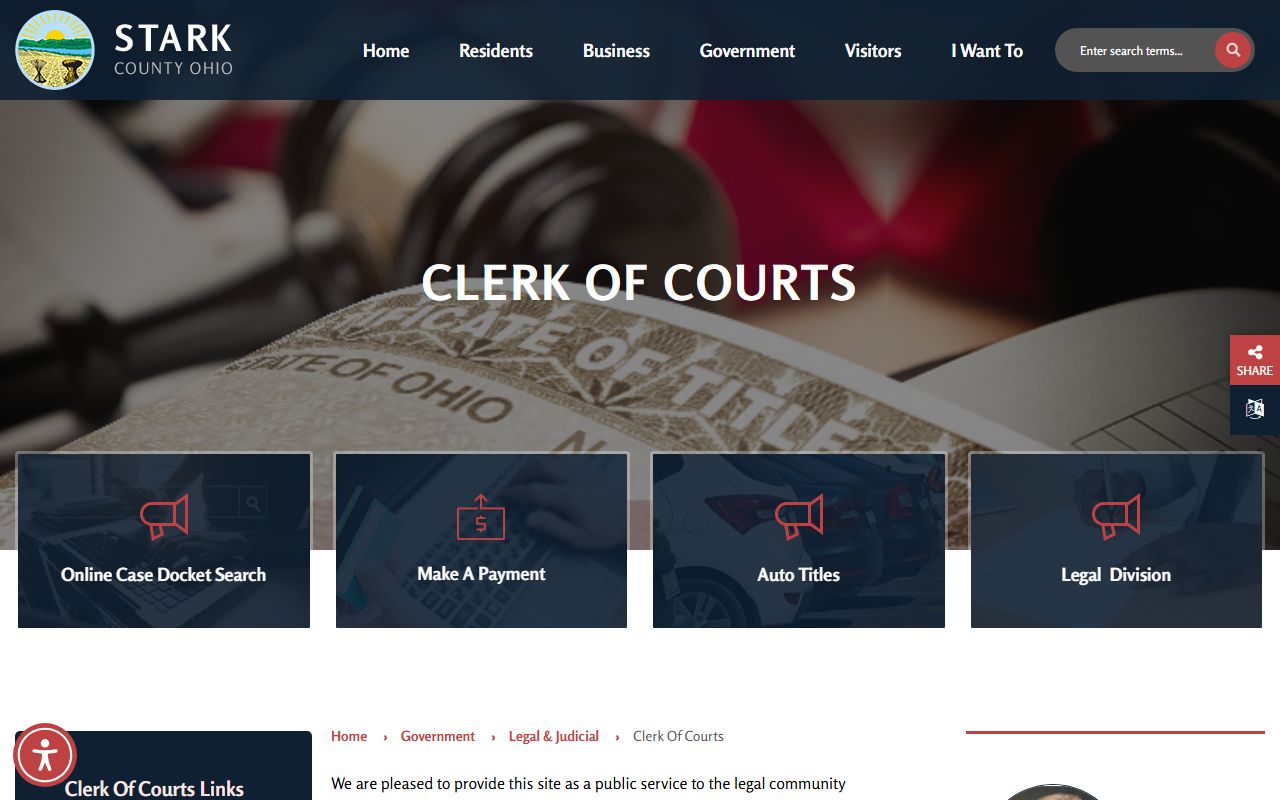
That warning is important because Stark County court records after arrest should be checked through official court or CJIS channels.
Stark County Charge Status Records
A charge status shows where an allegation sits in the court process. It is not the same thing as a booking note, and it is not the same thing as a conviction. Stark County court records may show pending charges, amended counts, dismissed counts, pleas, findings, sentencing entries, warrants, and probation or revocation events. When the jail and court records disagree, use the court docket for the formal case status and the jail route for custody.
| Status | What it means |
|---|---|
| Pending | The charge has not reached final disposition. |
| Amended or reduced | The filed count changed by prosecutor action, plea, or court order. |
| Dismissed | The court record shows the charge ended without conviction on that count. |
| Indicted | A grand jury returned a felony charging document. |
| Sentenced | The case reached a sentencing entry after plea or finding. |
Bond Records After Stark County Arrest
Bond records sit between jail custody and court case status. Ohio Revised Code Chapter 2937 and criminal procedure rules frame pretrial release. Common release types include personal recognizance, nonfinancial conditions, ten-percent deposit bonds, surety bonds, secured property or securities bonds, and full cash deposit. A no-bond hold or outside agency detainer can keep someone in custody even if one case has a release path.
| Bond type | Practical meaning |
|---|---|
| Personal recognizance | Release based on a promise to appear and follow conditions. |
| Ten-percent deposit | Deposit 10 percent of the bond amount, subject to court rules and costs. |
| Cash bond | Full cash amount posted as ordered by the court. |
| Surety bond | A licensed bond agent or surety backs the bond. |
| No-bond hold | Release is blocked until a court or holding agency changes the status. |
Stark County Pre-Trial Services was established in 1973 and assists Common Pleas plus Alliance, Canton, and Massillon Municipal Courts with release decisions. No official sheriff page with exact jail bond-counter hours or payment methods was found, so confirm the court order and payment route before traveling.
Warrants and Court Holds
The sheriff's Most Wanted page publishes selected wanted persons, but it is not a complete active-warrant database. Court dockets may show warrants, capias entries, failure-to-appear events, and holds tied to a case. Canton Municipal Court's 2024 annual report included 395 warrants on criminal cases for unavailability of the accused, which supports the point that warrants are court-specific and may not appear in a selected most-wanted list.
- Bench warrant
- A judge's order, often tied to missed court or violation of a court order.
- Capias
- A court writ directing that a person be taken into custody.
- Detainer
- A hold or request from another jurisdiction or agency.
Charges vs Convictions
Court records after a Stark County arrest should be read with care because a charge is an accusation, not a conviction. A prosecutor may add, reduce, or dismiss charges. A conviction usually follows a plea, verdict, or finding, then a sentencing entry. A public docket can show both dismissed and convicted counts, so the disposition field matters more than the existence of an early charge line.
| Charge | Conviction | |
|---|---|---|
| Stage | Accusation filed in court | Final result after plea, finding, or verdict |
| Meaning | Not proof of guilt | Court finding or plea accepted |
| Where shown | Complaint, information, indictment, docket | Docket and sentencing or disposition entry |
Sealed vs Expunged Records
Public access has limits. Juvenile records, sealed cases, expunged matters, certain personal identifiers, medical details, Social Security numbers, and security-sensitive information may be restricted. Ohio public-records law allows access to records kept by public offices, but it does not make every field public. A person trying to remove or restrict a visible court or booking record should follow court sealing or expungement procedures rather than paying a private removal demand.
| Sealed | Expunged | |
|---|---|---|
| Public view | Hidden from ordinary public access | Treated as removed under the applicable order |
| Source | Court order controls access | Court order controls the record effect |
| Lookup impact | May disappear from public case search | May not appear in ordinary public records |
Important: Do not use court records after a Stark County arrest for employment, tenant, credit, insurance, or other FCRA-covered screening.
Public Record Search
Sponsored Results